

Chasing footnotes, keeping faces in frame, and finally giving George someone to talk to.
On the D. B. Cooper page of Bloody Likely, there’s a sentence about a man walking up to the Northwest Orient counter in Portland and asking for a one-way ticket to Seattle. Two little numbers sit at the end. The first points to Wikipedia. The second leads to a newspaper story from 1994, preserved in the Wayback Machine.
When I started building the site, I would’ve stopped at the Wikipedia page. It took me two summers to build what happens when you follow the other link.
On July 5, 2025, I opened a v0 template called “True Crime Community Website.” It already had an evidence board, investigation threads, and a place to comment. I renamed it Bloody Likely that afternoon. The idea was that people could follow a case and compare notes. First I needed to give them some cases to follow.
I built an importer that worked its way through Wikipedia lists, tables, and categories and rewrote the articles into case files. A queue let it keep working overnight. One of the things I had to teach it was that a link to San Diego was probably there because something happened in San Diego. The city didn’t need its own case file.
By the end of that summer, I had a Next.js site and React Native apps for iOS and Android. You could save a case to your watchlist on your phone and find it on the web. When I picked the project back up the following spring, I had three places to read the same article. If somebody asked where I got a detail, the best I could usually do was send them back to Wikipedia.
Where did that sentence come from?
In June 2026, I changed what happened when I gave Bloody Likely a Wikipedia link. The importer could follow the references at the bottom, fetch the reporting behind them, and ask OpenAI to pull out one factual claim at a time. Each claim kept its source. After removing duplicates, a separate pass wrote the case file from those claims and attached citations where it used them.
Then I had the model read the draft against the claims. One thing I specifically asked it to look for was an allegation that had become a conviction somewhere in the rewrite. A sentence can get a lot smoother when you take out “prosecutors alleged.” It also says something different about a real person.

The fact-checking pass returns a report. This little TypeScript function decides what the publishing code can do with it.
export function evaluatePublish(
verification: VerificationGateInput | null | undefined,
force = false,
citationGate?: CitationTierGateInput | null,
): PublishDecision {
if (!verification) return 'needs_verification'
if (citationGate?.contentSource === 'ai_refresh' && !force) return 'blocked'
if (citationGate?.allCitationsWikipedia && !force) return 'wikipedia_only'
if (verification.publishable === false && !force) return 'blocked'
return 'ok'
}
That first check applies even when I set force. I can overrule a report I’ve read. I still have to get the report. On the normal path, an article that cites Wikipedia six times comes back as wikipedia_only. And when the system drafts an update to an existing case, it waits for me to approve it before replacing what people are reading.
By July, I could start a case from a set of source links even if nobody had written a Wikipedia page about it. The older adaptations still have a place on the site. Each article carries its own license, and readers can browse the Original Case Files separately.
Keeping faces in the frame
Most case files open with a photo of a real person: a mugshot, a yearbook portrait, a family snapshot that ended up in the newspaper. My headers are wide, and when a browser crops a portrait to fit a wide box, it keeps the middle. On a portrait, the middle is mostly chin and collar.
In June, I started running Google’s MediaPipe Face Landmarker over header images. It finds the eyes, and the point between them becomes the anchor for the crop. MediaPipe doesn’t run in Node, and a headless browser wasn’t going to fit inside a Vercel function, so detection happens in my own browser, in the admin, when I pick or replace an image. Nobody reading the site ever runs it.
What gets saved is geometry: where the eyes are and a box around each face, as fractions of the image. There’s no face recognition and no record of who anyone is. Some of these faces belong to victims, and the crop only needs to know where they are. If I set a focal point by hand, mine always wins, and automated detection never overwrites it.
Getting the eyes onto the page was the harder part. I assumed object-position: 48% 31% would show that point. It doesn’t. CSS lines up the 31 percent line of the image with the 31 percent line of the box, so with a modest crop, the face barely moved. The fix was to solve it backwards from the image and container sizes:
// visible: how much of the cover-scaled image fits on this axis (0–1)
// target: where the eyes should land in the box (one-third on wide headers)
const solve = (focal: number, visible: number, target: number): number => {
if (visible >= 0.999) return clamp01(focal)
return clamp01((focal - target * visible) / (1 - visible))
}
On a wide header, the eyes land on the upper third line, about where a photographer would put them. Every field in the crop data is optional, so the phone app already in the App Store ignored it until a later release taught its cards to use it.
In July, the rest of the media got the same idea. Photos, maps, and videos are pinned to specific paragraphs. Each paragraph ID includes a fingerprint of its text, so I can insert a paragraph near the top of a story without moving every map below it to the wrong place. Images with unclear rights stay in a review queue instead of being copied to my storage, and YouTube recaps that lean sensational never make it onto the public page.
Getting back to the paragraph you heard
Audio started as a button only I could see. On June 12, I hooked up ElevenLabs to read a case file aloud. By the end of the day, visitors could listen to the saved recordings and I’d already fixed a bug where skipping ahead sent you back to the beginning. Supporting HTTP Range requests let the server send just the part of the MP3 the player had asked for. A twenty-minute story is a pretty good way to find out whether seeking works.
A month later, I added a second voice from OpenAI’s gpt-4o-mini-tts. It’s cheaper, and it only gets generated the first time somebody presses play on a case. That became the free Standard narration. ElevenLabs became Premium.
Say you’re listening to the Cooper file and hear a detail you’d like to check. The recording is almost twenty-three minutes long. Where in the article should the player put you?
I already had those paragraph IDs, and Jump to Text uses them too. It counts the words that actually get narrated and gives each paragraph a proportional slice of the recording. A narrator who pauses for effect can throw the estimate off a little. I can live with landing a paragraph early if the alternative is scrubbing back and forth trying to find a name I’ve only heard out loud.
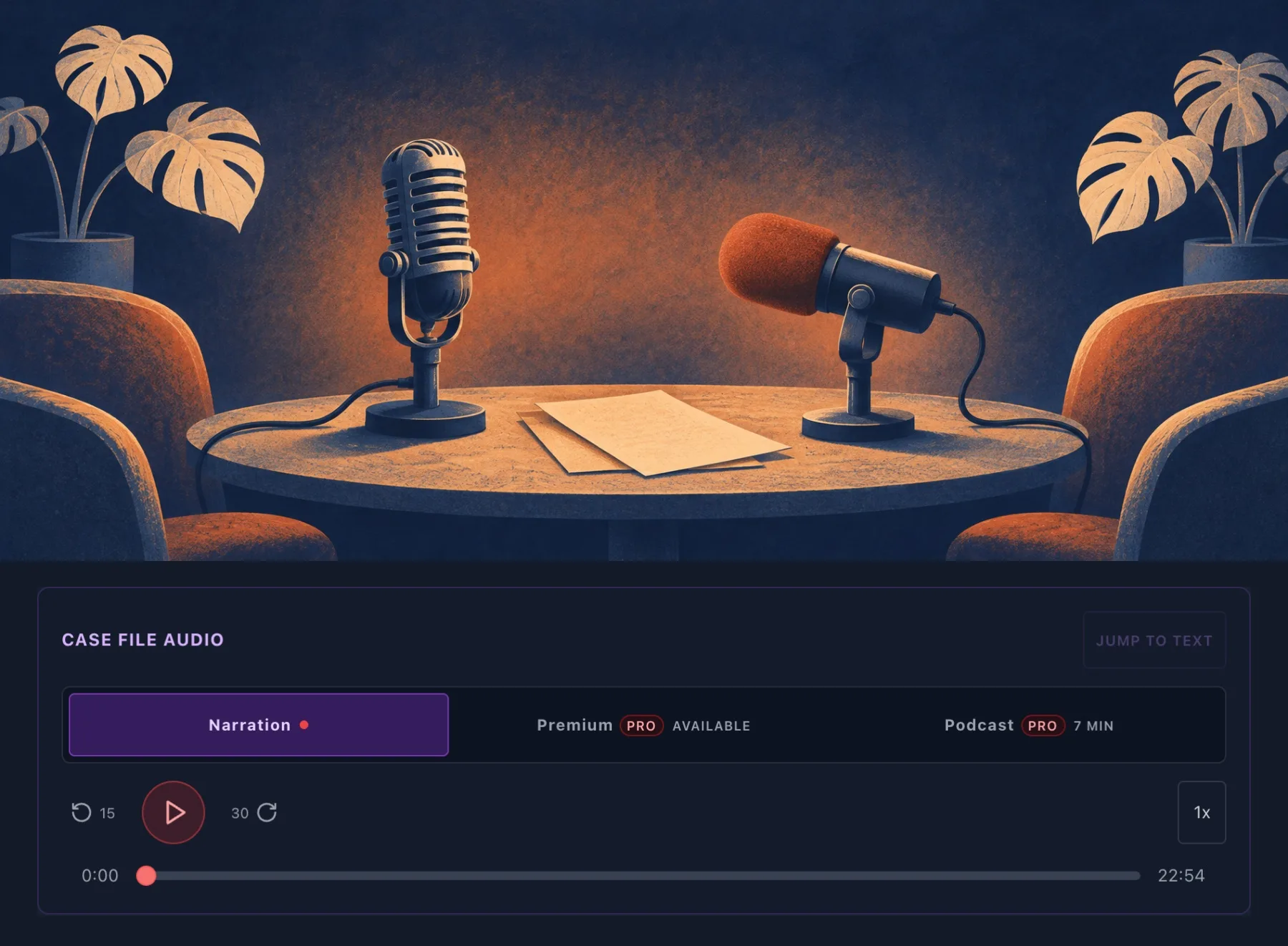
The podcast took more work. George and Emma are two AI hosts working from the same case material. The first episode to finish was D. B. Cooper’s, on August 7. The attempt before it failed because my ElevenLabs API key didn’t have permission to create projects.
I’d picked Cooper on purpose. Any case on the site can become an episode now, but the first one was going to be a test, and I wanted the test to be a case where a mistake wouldn’t land on anybody’s family. My list of candidate cases had a note beside each one about how an episode would treat the victims. Cooper’s note was short: a non-violent mystery.
When I pressed play, George interviewed himself about D. B. Cooper. The script had two names in it. The audio settings had the same voice ID for both. I had built a fairly elaborate system for making sure a man took turns talking to himself. Now the code checks the voices too. If George and Emma match, Emma gets her own voice back, and if they still match, nothing gets generated.
The next evening, I stopped handing ElevenLabs a case briefing and hoping a conversation came out. OpenAI writes the script now, and code checks it before any audio gets made. There have to be at least twelve turns, George gets between 48 and 72 percent of the words, neither host gets five turns in a row, and the episode has to end with a thank-you. If a draft fails, the writer gets one more try with the specific reasons it failed.
The checks only cover the shape of the conversation. What George and Emma are allowed to say is set by a list of rules that goes into every script. They can only use facts from the case file. Anything unproven stays “alleged” until there’s a conviction. Victims and their families get treated with respect, with no jokes and no lingering on violence. And if the source doesn’t say something, the hosts say that instead of filling the gap.
Enough to listen to
By then I had the code for a $4.99 monthly subscription ready. On August 8, I hid the upgrade button. Checkout could take someone’s money. I wanted them to have a good answer to “What should I play next?” and at that point the answer was mostly D. B. Cooper.
Hiding the button didn’t give the billing code a break. On August 13, I found that a Stripe sandbox purchase, the kind you make with a test card, could turn into real Pro in production. Paid subscriptions now have to show they didn’t come from a sandbox. The promotional grants I hand out myself still work.
At 2:32 a.m. on August 14, I became Bloody Likely’s first real subscriber. Production recorded my purchase as real, and it ignored the sandbox purchase I made to test the fix. My inventory that day listed 468 cases with free Standard narration, 48 with Premium narration, and eight podcasts.
With Bloody Likely Pro, a member can spend one of ten monthly credits to create a missing podcast or Premium narration. Once it’s ready, every Pro listener can play it. That gave me a good reason to write a slightly ridiculous database test. It asks for the same case 25 times at once and checks that Postgres creates one job and reserves one credit. The other 24 requests can wait for that recording.
The subscription is a single RevenueCat entitlement sold through Stripe on the web and through the App Store, and I use the same account ID in Supabase and RevenueCat. Your subscription follows your account, not the store you bought it from.
The cases I won’t advertise
Once people could pay, they had to find the place. In 2025 I’d written a generator for Instagram and X posts. In August it grew into what I call the Social Content OS: post templates, a weekly queue, rendered post cards, UTM links, and publishing through Upload-Post.
The part I care about most runs before anything gets written. Every case gets a color. Red means sexual violence, a child victim, a mass casualty, suicide or self-harm, graphic violence, or something that happened in the last two years. Posts about red cases are rejected automatically. Yellow covers things like abductions, serial killers, and cases from the last five years, and those wait for my approval. Only green cases go out on a schedule, and by default the same case can’t come back for 21 days.
In true crime, the red cases are a lot of what people click on, so this probably costs me some traffic. Those cases still get full case files, and anybody can find them on the site. They just don’t get promoted.
If you want to try Bloody Likely, I’d start with the Cooper file. The standard read is free, and Pro is open if you’d like to hear George and Emma’s version.
When you get to the one-way ticket to Seattle, skip the first little number and click the second. That’s the one that took two summers.